Fresh egg pasta has traditionally always been made with white flour obtained from soft wheat. Both fresh pasta made with whole wheat flour and pasta made from mixtures of soft wheat flour and durum wheat semolina fall outside the purest Italian tradition.
Following that strong and very Italian tradition in gastronomy, I always recommend the use of soft wheat flours 00 or 0. The equivalents in the Spanish classification of flours are:
- Type 00 flour (cake flour or all‑purpose flour) typically contains 9.5% protein and a low ash content. It’s the flour many Italian experts recommend for fresh pasta with a rougher texture due to its lower protein content.
- Type 0 flour corresponds to bread flour.
As for the proportions of flour and egg, the rule is: 1 egg for every 100 grams of flour and approximately 20 g of flour to work the dough.
Italians eat pasta as a first course (primo piatto) and the serving per person is usually about 75g of pasta per person.
Cooking Fresh Pasta
- Always cook with only boiling water and salt, except in the case of filled pasta, where a drizzle of olive oil is recommended to avoid friction between the pasta, thus preventing it from breaking and the filling from coming out.
- Water needed: for every 450g of fresh pasta, 4 liters of water; for every 225g of pasta added to this initial amount, 1 liter more of water should be added.
Ingredients (for 4 people)
| Ingredient | Amount |
|---|---|
| Wheat flour (type 00 or 0) | 500 g |
| Medium eggs | 5 |
How to Make Homemade Fresh Egg Pasta?
Difficulty: Medium
Total time: 30 minutes (preparation) + 1 hour rest
Elaboration: 30 minutes
Rest: 1 hour
Instructions
- On a clean work surface, make a well in the flour and crack the eggs into it. Knead gradually, mixing first with your fingertips and then with your whole hand. Knead vigorously until everything is well combined. You will obtain a slightly firm dough that no longer sticks to your hands. If it is too dry, add a little water; if it is too wet, add a little flour. The consistency depends on the type of flour and egg size, but the general rule is one egg for every 100g of flour.
- Wrap the dough in cling film to prevent drying out and let it rest for one hour. This allows the protein to develop, firm up, and become more elastic, which helps when stretching it.
- Once the dough has rested, divide it into portions and shape them into balls. Sprinkle a little flour on the work surface and roll out each ball with a rolling pin. It’s important to create a thin, rectangular sheet so that when you cut it, you get nice strips of pasta.
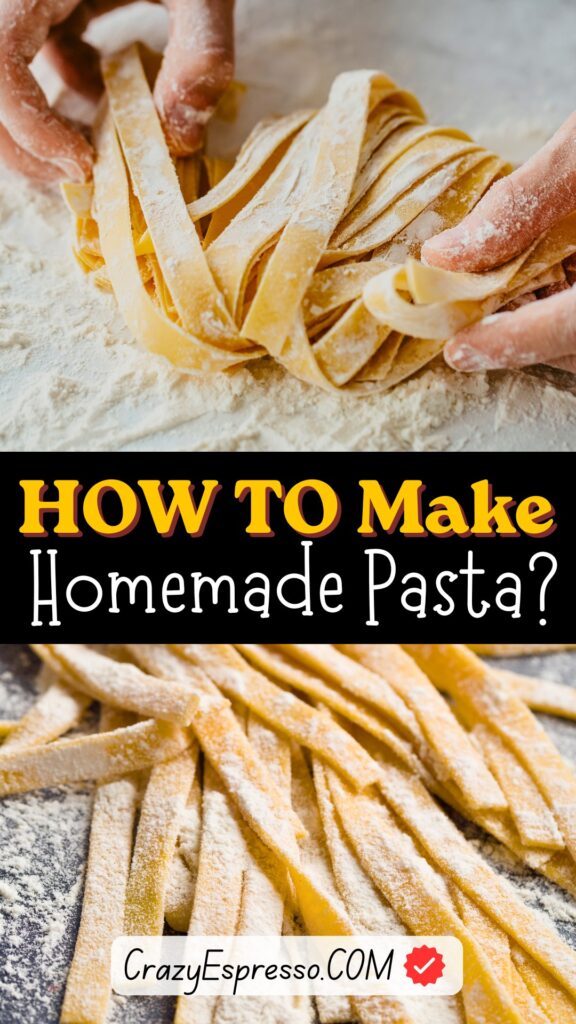
- There are countless ways to cut and shape pasta. We opted for tagliatelle, which is very simple. Sprinkle each sheet with a thin layer of flour and fold it in a zigzag pattern. With a sharp knife, cut one‑centimeter pieces. Place the pasta pieces on a board, forming nests with each one, and cover them with a cloth while you continue cutting the rest.
- Once ready, simply cook it in salted water. Pasta experts recommend 10 grams of salt per liter of water and one liter of water per 100 grams of pasta. If you don’t want to measure precisely, use plenty of water so the pasta releases the flour clinging to it and cooks freely.
- The cooking time depends on the thickness of the pasta and whether it’s filled or not. It can vary from two to five or six minutes. Taste it before removing from water. We like to leave it slightly firm so we can give it a final simmer in the sauce to achieve an al dente texture.
Video Guide 📺
Nutritional Facts (estimated, per serving – 1/4 of recipe)
Serving size: approximately 185–190g of fresh uncooked pasta dough
| Nutrient | Amount per serving |
|---|---|
| Calories | 535 kcal |
| Carbohydrates | 95 g |
| Protein | 20 g |
| Fat | 7.5 g |
| Saturated fat | 2 g |
| Cholesterol | 195 mg |
| Sodium | 75 mg |
| Fiber | 3 g |
| Sugar | 1 g |
Note: Values are estimates based on 500g type 00 wheat flour and 5 medium eggs (50g each, no shell). Actual nutrition may vary by flour type, egg size, and preparation.