Knowing how to clean your oven is essential for maintaining this appliance in good condition and extending its lifespan. Cleaning should be done after every use, even if nothing has spilled from the baking tray.
The same steam generated inside the oven when cooking a sweet or savory meal makes it dirty, causing a large proliferation of bacteria and dirt that will be added to the next meal if we don’t clean it.
When an oven is dirty, it generates smoke and unpleasant odors that sometimes emanate from it even when it’s turned off. Therefore, keeping it clean is a priority, and depending on the type of oven, there’s a different and specific cleaning technique.
Recommendations before cleaning any type of oven
Choosing the right cleaning material is very important, as some are too abrasive and unsuitable for cleaning this appliance. This is mainly because they can damage the enamel, glass, or internal components.
Do not use a stiff-bristled brush or steel wool for cleaning. A cloth is sufficient to properly clean the entire interior of the kitchen.
If it has any electrical connections, it’s best to unplug it before starting to clean. Likewise, all internal accessories, such as grilles, should also be removed.
Use gloves to protect your hands from any damage caused by the product or the oven’s temperature. Here are several simple and effective ways to clean your oven, depending on the type of oven you have.

How to clean a gas stove oven?
Gas stoves are the most common type of oven found in homes. Cleaning should be done a few minutes after removing food from the oven, especially if any spills have occurred, as these can clog the burners.
Ideally, wipe the entire interior of the oven with a cloth dampened with water and a little dish soap before it cools down completely. The idea is to ensure the oven’s interior temperature is still warm enough to prevent burns and that the grease is still soft.
However, it’s more common to leave cleaning it until last, and in that case, we must resort to other, more effective methods. Whichever method is chosen, the cloth must be smooth to avoid scratching the oven’s interior, which may be enameled, glazed, or made of another self-cleaning material.
Remember that cleaning and properly maintaining your gas stove will keep your family safe. If you smell gas, you should call a professional gas fitter or plumber.
Clean the oven with baking soda
Baking soda is one of the most commonly used ingredients for cleaning a very dirty oven. This is because it’s a natural product with strong abrasive properties that doesn’t cause any adverse health effects or damage to the oven’s materials.
To prepare the cleaning solution, mix half a cup of baking soda with enough water to form a paste that you can spread inside the oven. Let it sit for 12 hours, then remove all the paste with a damp cloth.
Try to remove as much of the paste as possible with the damp cloth, then put some vinegar in a spray bottle with water and spray the entire interior, especially where you notice the paste isn’t coming off.
When vinegar comes into contact with baking soda, a foam forms that is very easy to clean. Once the oven is free of any traces of dirt, turn it on for about 10 minutes to ensure it dries completely.
How to clean the inside of the oven glass?
Applying baking soda as a paste is a very effective way to clean the inside of the oven glass without scratching it. In this case, you only need to leave the paste on for half an hour.
After that time, remove all the paste with a damp cloth, and the glass will be spotless.
How to clean an electric oven?
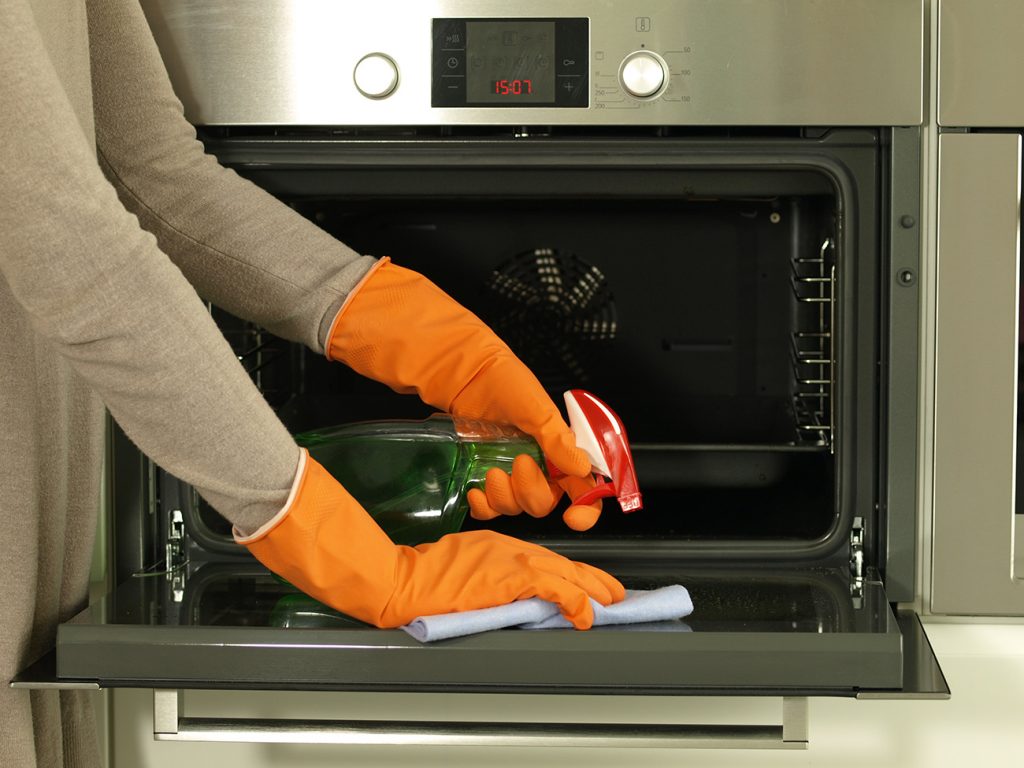
Electric ovens are a great solution for kitchens because they are easy to connect, compact, and easy to clean. Cooking in these ovens is done using electric heating elements; some models even have internal fans that allow for more even cooking.
The recommended cleaning method is the same as for gas ovens, with the added precaution of unplugging the appliance before starting. Most importantly, some models have a self-cleaning function.
For this to work, the oven must be left on, without any accessories inside, for at least 15 minutes in the middle position. During this time, the porous material lining the interior traps the grease generated during cooking and carbonizes it. As it cools, it turns to powder, which can be easily removed with a damp cloth.
In the event of any spillage or splashing, it will need to be cleaned with a sponge first before starting the cleaning process mentioned above.
If a deeper cleaning is needed, it is not recommended to use abrasive materials or brushes to avoid damaging the self-cleaning coating. A very effective cleaning technique for these cases is the baking soda paste mentioned for gas ovens.
How to clean a microwave oven?
The speed at which a microwave cooks or heats food is unparalleled. It’s often used frequently, especially when we’re short on time—time we also don’t have for a quick cleanup afterward.
For this reason, the microwave often ends up with some splatters of food previously cooked in it. This situation is not only unhygienic but also affects the microwave’s effectiveness.
Therefore, it is recommended to clean the microwave as often as possible and, of course, with natural materials, since the most abrasive ones can damage our health and the microwave material.
The methods mentioned for gas stoves or electric ovens are very effective for cleaning microwaves. But here, we add two more methods that will give you some advantages when it comes to microwave ovens.
Clean the microwave with lemon
A very effective way to clean your microwave is with lemon. Simply place the juice of one lemon in a glass of water and microwave it on full power for a few minutes, until the glass door fogs up.
During that time, the lemon will naturally soften all the dirt, allowing you to clean it with a damp cloth. An added benefit of using lemon is that it leaves behind traces of its characteristic fragrance.
How to disinfect a microwave?
If you want to disinfect your microwave in addition to cleaning it, you can clean it with vinegar. Vinegar doesn’t have the pleasant aroma of lemon, but it has a great advantage: it disinfects.
To begin cleaning, place a tablespoon of white vinegar in a glass filled with water. Put the glass in the microwave and turn it on to full power for a few minutes, until the glass fogs up.
After removing the glass, proceed to clean the entire interior with a damp cloth and a few drops of vinegar. You might be worried about the strong vinegar smell, but don’t be; it will disappear completely once dry.
All these oven cleaning methods are efficient and safe, both for your health and the lifespan of the appliance. Remember that in addition to cleaning, you must consider safety. Therefore, if you want to move your gas stove or replace it with a different type of oven.