Summer is approaching, and the atmosphere is heating up. But it’s not all fun and games; for some, June becomes a real nightmare, and not just because of the heat.

There’s less than a week to go before the university entrance exams begin in Catalonia, and it’s time to prepare for the final sprint.
Most students probably have everything more than under control, right? Well, if you’re not feeling entirely confident, don’t worry, today we’re bringing you some tips for memorizing quickly. But you really need to get started right away!
Work on your memory, don’t forget!
The first thing you need to understand is that memory isn’t a divine gift. So stop saying things like, “I’m just not good enough,” “I can’t remember things,” or “I’ll just draw a blank.” Memory is something you can train to learn how to memorize things quickly.
Some memorization experts, like Alex Mullen, can memorize more than 550 numbers in under 5 minutes. And then we can’t even remember the PUK code on our mobile phones, which is 8 digits.
Mnemonic Rules
Mnemonic devices allow us to simplify concepts by associating, grouping, or translating them into something familiar or easier to remember. Thanks to these techniques, we can significantly reduce memorization time and thus facilitate recall.
These techniques are used when you need to remember concepts, formulas, numbers, words, phrases, lists, or diagrams.
If you understand each of the concepts you need to study, these techniques will help you organize them or quote a list in an exam.
Today, we bring you 5 techniques for memorizing quickly so you can get the most out of your study time.
1. Relate concepts
Most of the “tricks” experts use revolve around this point: translating complicated concepts into simpler, more familiar things. Even if you think you’re going off on a tangent comparing meaningless concepts, don’t worry. If you’ve chosen that connection, it’s because it’s the first thing your brain associates with that concept. You’ll see how easily you remember it on exam day.
You can use this technique by relating what you are studying to images, words, a letter, a number, or familiar places—whatever is easiest for you to remember.
2. Create an interesting story
If the topic you’re studying is boring, you’ll likely find it harder to remember. Imagine it in a more fun and easier way to learn. Make up a story with characters you find funny, or turn it into something you know perfectly well.
3. Letters and numbers to remember large lists of words
Letters are a very useful technique for memorizing lists, perfect for exam periods. With this method, you can memorize lists of more than 50 words if you dedicate a few hours to it.
You simply have to remember the first letter of each word, and for those that are repeated, write down the number of times they appear. V-5 means there are five words that begin with V.
Do the same with the others: R-2, F-4, and so on. You’ll see how much easier it is to remember them all.
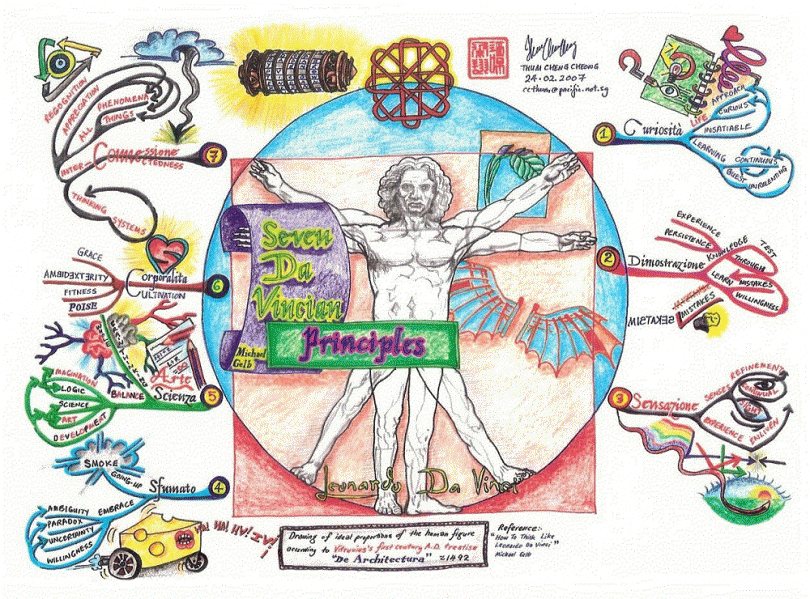
4. Draw a mind map
This method is ideal for those with good visual memory and is used to organize information through connections. Students are very accustomed to using it. It simply involves using the simplest possible diagram to establish connections.
A good way to differentiate concepts is to use different colors or create a symbol to represent each category. This will be very helpful for grouping concepts into different categories.
5. Create many connections
If you want to retain information for a long time, find plenty of information that reminds you of that concept. You might think this could confuse you even more, but it won’t. The more connections you make for a concept, the easier it will be to remember it, for longer, and in more detail. You should look for many relationships, so you can write down the concept and then write words or things around it that will remind you of it.
- Bonus Tip – Put it on paper
This advice applies to all the previous ones as well. I imagine many of you already do this, but for those who still try to memorize by simply repeating the words endlessly in their heads, don’t waste your time. Write it down, jot it down, draw it, paint it on a wall if necessary. The more you write it and repeat it, the more your brain will internalize it and the easier it will be to remember.
- Bonus Tip 2 – Train
Don’t you ever read really fast but miss half the point? That’s because of poor memory. One way to improve it is to try making lists for everything and repeating them. You can also try remembering phone numbers instead of writing them down directly on your phone, or your shopping list—try memorizing it without having to write it down.
How can I memorize a presentation?
- Underline relevant words. Begin by reading the information in the presentation and mark the relevant titles and verses. If you have time, ideally you should read the entire text once, then read it a second time to reinforce your understanding, and a third time to underline the text.
- Create a summary document. Once you have underlined the key points, use that material in a new document, combining the selected sections and trying to make sense of them and establish connections between them.
- Replace the words. Once you have your summarized document, replace any words in the text that you found difficult with more common synonyms or words that are easier for you to use. This will help you express yourself more easily. Keep in mind that you cannot change the main idea that the text conveys.
- Identify keywords. When reading the new document, mark the keywords that serve as connectors so you don’t forget the content or order of the presentation.
- Keyword association. Similarly, as you read this new text, associate the keywords you have chosen with an image or something that reminds you of that word; this way you won’t forget where you are in the presentation.
- Be prepared to improvise. Practice your presentation, and be ready to improvise if you get stuck or forget a point. Use a phrase in your own words to give yourself time to remember where you left off, thus avoiding an awkward silence.
We hope you practice this process for memorizing a presentation and achieve successful results.
Calm down, you’ve got it!
Okay, these are some tips that many of you probably already put into practice, but it never hurts to be reminded. For all of this to work, it’s important that you take it easy.
The worst thing you can do is get overwhelmed. Your brain will have a hard time remembering if you’re constantly thinking about what might happen.
Calm your nerves and optimize your study time with techniques. Even if you think it takes a little more time, it will be much more effective than reading the lesson 40 times.
Yes, you might start remembering things on the fourth reading, but if you start step by step, point by point, applying these techniques, you’ll only need to review it afterward. And very importantly, let your mind rest.
Sleep well, take some time to go out and disconnect , do some exercise—whatever kind you like—but forget about studying for at least an hour, and then you’ll see how everything comes naturally.
Good luck to everyone!