Many of us, during our student days, have experienced being bored in class and finding ourselves doodling on a sheet of paper in our notebooks; or perhaps while talking on the phone with friends or family, we discover that we’ve created a magnificent work of art on a scrap of paper, maybe on a napkin from a bar, cafe, or on the back of a utility bill. Who hasn’t done that?

Discussing doodling and sketching as preliminary steps before beginning a work is fundamental for any draftsman or visual artist. Both actions are related within the family of drawing, though their functions differ somewhat when put into practice.
While doodling arises spontaneously, which we can define as an act of distraction and entertainment, sketching is a step prior to the creation of a final work, something like a preview of the work we are going to execute.

This leads us to wonder: is a sketch or not a doodle? Although it begins on paper with a certain ease and freedom, we can assume that there’s already an idea planted in our minds, giving us a reference point for what we want to create.
Since a doodle is a free expression from beginning to end, without any creative limitations, this is why sketching and drawing are both closely related and opposite in definition. Let’s look at these actions separately to better understand what each one entails and what the advantages are when executing them on paper.

Doodles are moments where we let ourselves be guided by intuition and the curiosity to see how what we’re creating will develop, without a concrete idea. It’s an expressive, spontaneous, and artistic moment where the mind gives free rein to a space of intuitive exploration. It also helps us be more creative, as it serves as a trigger for ideas.
Currently, studies in neuroscience, psychology, and design have revealed that drawing and doodling improve comprehension and creative thinking, helping with concentration, productivity, staying present, and generating ideas. Furthermore, doodling promotes greater information retention and reduces anxiety levels.
Some recommendations and tips for making your doodles:
- Using your freehand and holding the pencil in a way that’s different from what you’re used to will make your brain and creativity work in a more expressive and creative way.
- The movement of the entire arm and the use of the entire wrist through its 360° range of motion. Many of us have become accustomed to resting our hand on the abductor digiti minimi muscle when drawing, and this limits our range of motion to a 90° movement with respect to the wrist’s range of motion.
- Always carry a notebook or notepad with blank pages, a pencil, a pen, and any other items you might need for drawing in your bag or backpack so you can draw at any time.
- Unleash your creativity and have fun!
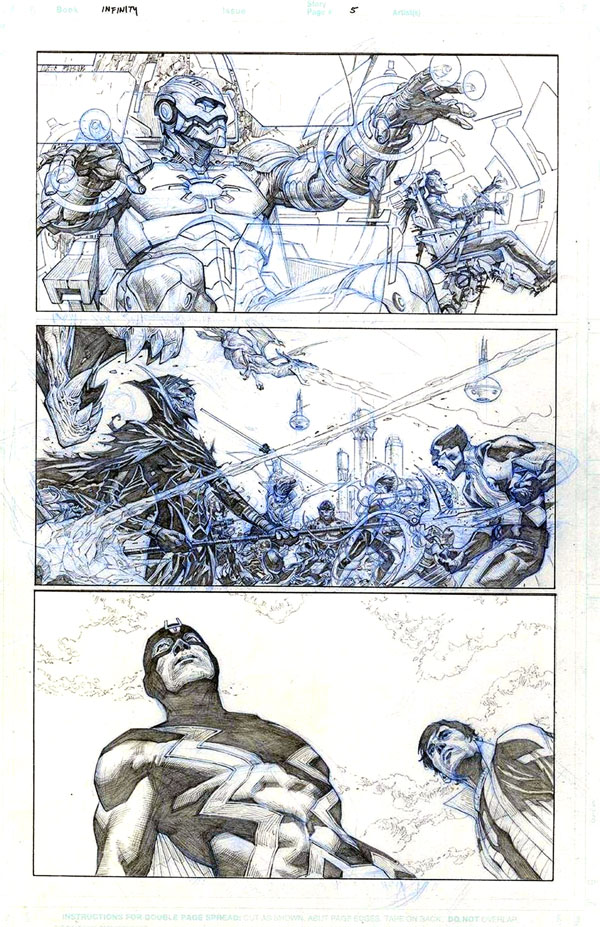
The sketching process in comics is largely tied to the interpretation of the script, with the artist’s job being to achieve the best visual translation for the reader’s comprehension of the final work. For this reason, when producing the pages, the first step is to sketch the panels. This process allows us to have a broad overview of what the final result will look like.

The sketch can be further divided into three sections:
- The artist makes a very simplified sketch or model where he takes notes for some future modifications, which in film or animation are called layouts.
- The sketch is where we begin to place the figure in the panels and define the actions of the script. Some artists practice this on a separate sheet of paper and then transfer the idea to the final page, while others work directly on the page to save time.
- The final pencil: when we already have the page defined, the idea captured, and there are no modifications.
Following this process helps us balance our page and the work as a whole; by doing this step by step, we define the balance of planes, lights, and shadows, the tonal plan if using color, arrange the figures and text, and visualize the final page beforehand.

The sketch is to the artist what the rehearsal before the premiere is to the ballet dancer; that’s why it’s vitally important to do this practice before the final page. Doing the sketch is having a plan to avoid making mistakes before doing the inking work.
Some recommendations and tips for making your sketches:
- One helpful tip is to create drafts at the final publication size. This allows you to visualize the size of the figures the reader will see from the very beginning of the page layout.
- In the case of the comic strip sketch, always keep in mind the space that the texts will require.
- A page layout sketch is very useful for keeping your idea in mind when you’re feeling inspired. On an A4 sheet, you can draw four rectangles to simulate four pages, and then plan the placement of the boxes within them.
- You can try using a light blue pencil to sketch the figures on the final page, including perspectives and objects on the plane; this allows you to position the elements within the page without interfering with the final pencil sketch. If you need to scan the pencil sketch in grayscale, the light blue color will barely show up in the scan.
- It’s advisable to draw as many sketches as necessary. The more sketches you make, the more ideas you’ll have about the final result, and it will give you confidence and ease when you begin working in pencil.
- Something to keep in mind is that there is a warm-up period in all sports so that the muscles can stretch and begin to work at their maximum potential; the same is true for artists. On average, after 30 or 40 minutes of working, our mind flows better, and our hand and wrist become more flexible and agile to carry out the task.
Finally, remember to be mindful of every step you’re taking. Of course, some details might slip through the cracks at some point, but the important thing is not to give up and to try to fix the problem before the final inking.

I hope these tips are helpful and serve as a tool for you to continue developing your own projects and move forward with future ones.
I also hope this article provides a broad overview and support for comic book artists regarding each of these processes individually, with a particular focus on expanding the horizons of beginners or amateur artists. Either of these exercises can serve as fundamental tools for all the projects you undertake in your future work.